IFC UN Women's Gender Collaborative 2025: Life Circle Champions Women's Safety and Care Innovation
Life Circle at the IFC UN Women's Gender Collaborative 2025
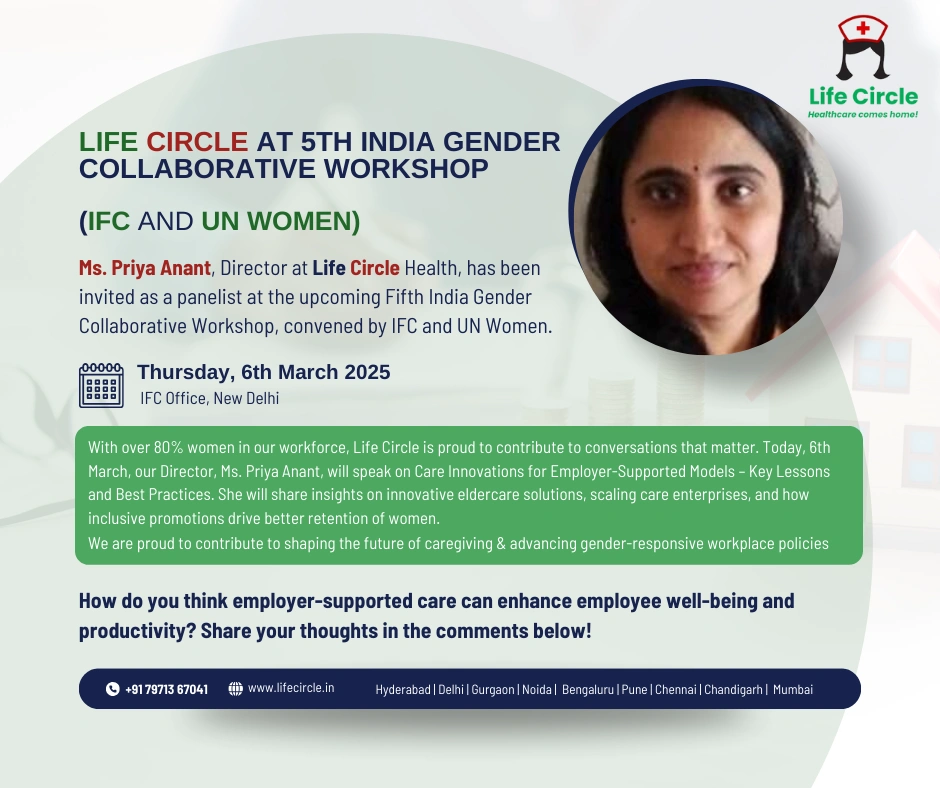
New Delhi, 6 March 2025 — Priya Anant, Co-Founder and Director of Life Circle Health Services, participated as a featured panelist at the 5th India Gender Collaborative (IGC) Workshop on Tackling Employer-Supported Care. The workshop was hosted jointly under the IFC UN Women’s Gender Collaborative 2025, themed Inclusive Promotions and Better Retention of Women.
This landmark event brought together senior leaders from business, government, and civil society to explore how gender-responsive workplace policies can meaningfully improve women’s participation, safety, and retention in the workforce. Central to the discussion was the urgent need to integrate care solutions that serve both employees and employers — a conversation that Life Circle has long championed on the national stage.
The IFC UN Women’s Gender Collaborative 2025 represents a critical platform for driving private-sector accountability and creating actionable frameworks that link women’s economic empowerment with the availability of quality care infrastructure. Life Circle’s presence at this forum reflects its growing role as a thought leader in India’s evolving care economy.
Priya Anant on Bringing the Care Economy into the Workplace Conversation
Representing Life Circle at the IFC UN Women’s Gender Collaborative 2025, Priya Anant brought a data-driven and deeply personal perspective to the panel. She began by underscoring how the lack of accessible eldercare is rapidly becoming one of the most significant — yet least discussed — barriers to women’s professional advancement in India.
Drawing on Government of India projections, she highlighted that India’s elderly population is expected to reach 193 million by 2031, making employer-supported eldercare not just a welfare consideration but a strategic business imperative. She further cited regional research from BCG to illustrate the scale of the challenge:
- 88% of Indian employees are also caregivers — significantly higher than the Asia-Pacific average of 60%.
- 71% face a dual burden of simultaneously caring for both children and ageing parents.
- Despite these responsibilities, caregiver employees are 96% more ambitious than their non-caregiver counterparts, actively seeking promotions and leadership opportunities.
These insights show that caregivers are not just managing care burdens — they are developing core workplace strengths like empathy, persistence, efficiency, and prioritization, Priya observed. The question isn’t whether caregiving affects performance, but how workplaces can recognize and support the value it creates.
Her remarks reframed the narrative around caregiving employees — shifting the perception from one of liability to one of untapped leadership potential. This perspective was particularly resonant at the IFC UN Women’s Gender Collaborative 2025, where inclusion and retention of women in senior roles were at the heart of the agenda.
The 16× Burden — Priya Anant's Case for Gender-Responsive Policy
One of the most compelling moments of the workshop came when Priya Anant introduced what she described as India’s 16× burden — a concept that captures the compounded weight of gender norms and multi-generational care responsibilities unique to Indian women.
Globally, people speak of a ‘double burden’ for working women, she explained. But in India, most women shoulder care responsibilities for both their own parents and their in-laws, making it a sixteen-fold emotional and physical load. To build truly resilient and gender-inclusive workplaces, we need to design systems that honestly acknowledge and actively support this reality.
Priya urged employers, HR leaders, and policymakers present at the IFC UN Women’s Gender Collaborative 2025 to integrate eldercare into Diversity, Equity, and Inclusion (DEI) frameworks — not as an optional employee perk, but as a foundational enabler of productivity, well-being, and equitable workforce participation.
Her call to action was clear: organizations that fail to account for the invisible care burdens their employees carry — disproportionately borne by women — will continue to lose valuable talent, particularly at critical stages of career growth.
Life Circle's Model for Employer-Supported Eldercare
Beyond advocacy, Life Circle presented a concrete, scalable model for how organizations can take action. Currently delivering over 100,000 days of home care annually, Life Circle is actively expanding its corporate partnerships to serve organizations that employ large numbers of dual-care employees.
Through customized eldercare packages designed for the workplace, Life Circle helps organizations build structured support systems that may include:
- Preventive health monitoring for employees’ ageing parents, reducing emergency absenteeism and caregiver anxiety.
- Caregiver education sessions that equip employees with the knowledge and tools to manage elder care responsibilities more effectively.
- On-site caregiving stationsor referral partnerships for short- and long-term care support, enabling employees to stay focused and productive at work.
Comprehensive, employee-centric DEI policies with genuine leadership accountability — not token gestures — are what drive retention, Priya emphasized. Paid care leave, anti-discrimination frameworks, and employer-backed support services must work in concert if we truly want women to remain in the workforce and rise within it.
This integrated approach positions Life Circle not just as a healthcare provider, but as a strategic partner for organizations committed to building inclusive workplaces — an alignment that resonated strongly with the goals of the IFC UN Women’s Gender Collaborative 2025.
Building Sustainable and Scalable Care Systems Across India
A significant portion of Priya Anant’s contribution to the IFC UN Women’s Gender Collaborative 2025 panel addressed the supply-side crisis within India’s care economy. Despite being one of the youngest countries in the world demographically, India faces a critical shortage of trained, professional caregivers — a gap driven largely by social stigma, low wages, and the absence of formal career pathways in the sector.
We are setting up ten training academies across India to build a professional caregiving workforce, Priya announced. But infrastructure alone is not enough. We must also change the narrative — caregivers are skilled professionals, not domestic workers. Dignity, fair compensation, and shared care models will make this sector both cost-effective and scalable.
By professionalizing caregiving, Life Circle aims to create a sustainable pipeline of trained care workers who can meet the growing demands of an ageing population while simultaneously providing dignified, stable livelihoods — particularly for women entering or re-entering the workforce.
This dual focus on supply-side investment and demand-side policy reform reflects the kind of systemic thinking that the IFC UN Women’s Gender Collaborative 2025 seeks to catalyze across industries and geographies.
Women's Safety and Dignity at the Core of Life Circle's Mission
As a home healthcare organization with a predominantly female workforce, Life Circle places the health, safety, and dignity of its caregivers at the center of its operations. Every caregiver employed by Life Circle is rigorously trained in workplace safety protocols, elder handling best practices, and emotional resilience — ensuring that safer, more supportive environments are created not just for care recipients, but for the women delivering that care.
This commitment directly aligns with the broader objectives of the IFC UN Women’s Gender Collaborative 2025, which seeks to create conditions where women can participate in the economy safely, equitably, and with full access to growth opportunities. For Life Circle, women’s safety is not a compliance checkbox — it is a foundational organizational value embedded in every service delivery model.
The organization’s approach demonstrates that building a gender-responsive care economy requires attention to both ends of the equation: supporting women in corporate roles who bear invisible care burdens, and protecting the rights and well-being of women who make professional caregiving their livelihood.
A Shared Responsibility — The Path Forward
Life Circle’s participation in the IFC UN Women’s Gender Collaborative 2025 underscores its leadership in advocating for inclusive, dignified, and sustainable caregiving ecosystems that benefit families, employers, and the broader economy. The event reinforced a central truth: women’s workforce participation and long-term economic growth are inseparable from the availability, affordability, and quality of care.
As India moves toward 2031 and beyond, the intersections of an ageing population, a young workforce, and persistent gender inequities in care work will demand bold, collaborative, and evidence-based responses. Life Circle, through voices like Priya Anant, is committed to leading that charge — partnering with corporations, policymakers, and international organizations to turn the care economy into a driver of gender equity and inclusive growth.
The IFC UN Women’s Gender Collaborative 2025 served as a powerful reminder that care is not a private matter — it is a public good, a business imperative, and a cornerstone of any meaningful commitment to gender equality in the workplace and beyond.