28-09-2025
7 Powerful Ways Caregiving Job Creation India Can Transform the Economy
Written By: Nagaraju Raparthi, Senior Content & Care Story Writer
Introduction: Caregiving Job Creation India — A Once-in-a-Generation Opportunity
Caregiving job creation India represents one of the most promising and underutilized economic opportunities of our time. India’s rapidly ageing population is creating one of the largest caregiving markets in the world. By 2050, nearly 20% of India’s population will be above 60 years, and millions of families will require structured, professional support.
At the same time, India continues to face significant unemployment and underemployment challenges — particularly among rural youth and women. Caregiving has the extraordinary potential to bridge these two realities, becoming a powerful job-creation engine while simultaneously delivering dignified, high-quality elder care to those who need it most.
In this article, we explore seven powerful ways that investing in the care economy India can generate meaningful employment, uplift communities, and build a sustainable future for seniors and caregivers alike.
1. The Scale of Eldercare Demand Is Driving Eldercare Jobs India
The numbers speak for themselves. Understanding the size of this opportunity is the first step toward unlocking it.
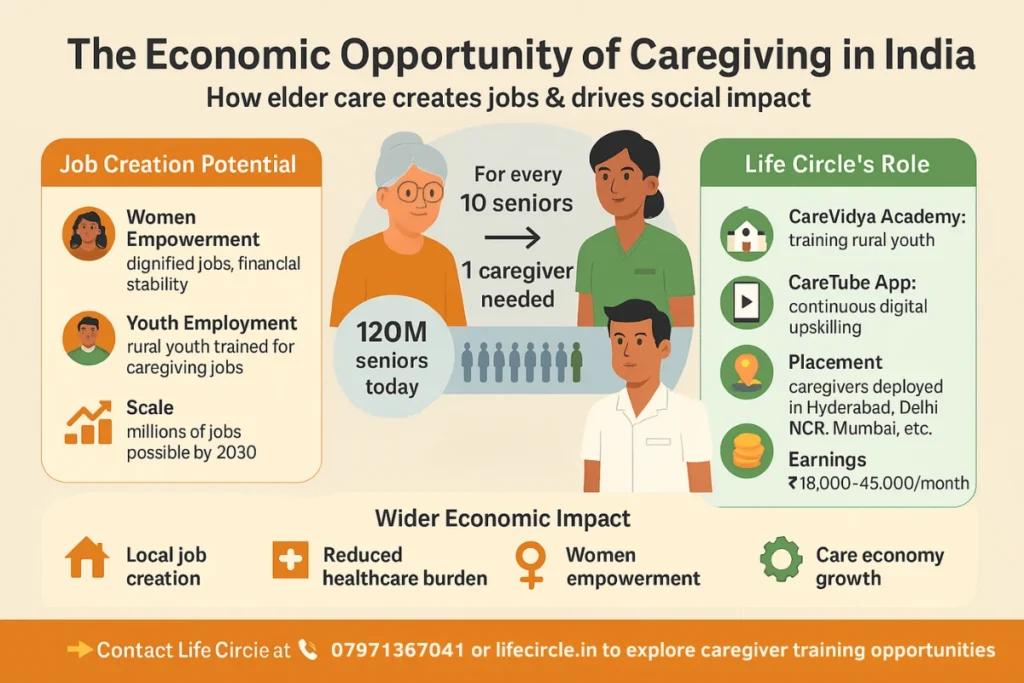
- Over 120 million seniors live in India today, a figure projected to double by 2050.
- There is an increasing prevalence of chronic illnesses, dementia, and palliative care needs among the elderly.
- Rapid urbanization and the rise of nuclear families are significantly reducing the availability of family caregivers.
- For every 10 seniors, at least 1 trained caregiver will be needed — translating into millions of eldercare jobs India by 2030.
- Caregiving employment can grow at scale, especially in Tier-2 and Tier-3 cities where formal jobs remain scarce.
This demand is not a future projection — it is already here. Families across India are actively searching for trained, reliable caregivers, and the supply is unable to keep pace.
2. Women Employment in Caregiving Offers Dignified, Stable Livelihoods
One of the most transformative aspects of caregiving job creation India is its profound potential for women employment caregiving. Across rural and semi-urban India, millions of women remain outside the formal workforce due to lack of access to training, proximity to job markets, and social barriers.
Caregiving breaks down these barriers in several important ways:
- Low entry barriers: Women with basic literacy and a compassionate disposition can be trained within weeks to deliver professional care.
- Formal employment: Unlike informal domestic work, caregiving offers structured pay, contracts, and career progression.
- Local and metro placements: Women can find caregiving roles within their own communities or transition to metro cities for higher earnings.
- Income impact: Earnings from caregiving support children’s education, family healthcare, and household financial stability.
- Dignity and respect: Caregiving is increasingly recognized as a skilled profession, changing social perceptions of women’s work.
For India to achieve genuine gender inclusion in its workforce, scaling women employment caregiving through structured training and placement is not optional — it is essential.
3. Youth Caregiving Careers Create Pathways Out of Unemployment
India’s youth unemployment challenge is well-documented. Millions of young people, particularly in rural areas, lack access to skilled employment opportunities and are forced into unstable, low-paying informal work or unsafe migration patterns.
Youth caregiving careers offer a credible, rewarding alternative:
- Rural youth can be trained locally in eldercare skills and placed in growing metro city markets.
- Caregiving provides a structured career ladder — from entry-level caregiver to supervisor, trainer, or healthcare support professional.
- Young caregivers can transition into allied fields such as nursing, physiotherapy assistance, geriatric care management, and even international caregiver roles in countries like Japan, Germany, and Canada.
- Youth caregiving careers come with measurable earnings growth tied to skills and experience — a powerful motivator for continued learning and development.
Investing in youth caregiving careers is not just about filling a workforce gap. It is about giving India’s young people a future they can be proud of.
4. Building a Structured Care Economy India Can Learn from Global Leaders
The concept of a formalized care economy India is not new globally. Countries that faced rapid population ageing decades ahead of India have already demonstrated how eldercare can become a structured, high-value industry.
- Japan has built a multi-billion-dollar eldercare industry employing millions through government-backed insurance schemes and professional caregiver certification programs.
- Germany has integrated caregiving into its national healthcare system, creating stable, well-paying jobs backed by regulatory standards.
- Singapore has invested in tech-enabled eldercare solutions, combining human caregivers with digital monitoring to improve quality and efficiency.
India can replicate and adapt these global models while addressing its unique socio-economic context — particularly the opportunity to leverage its large, young, trainable workforce. Building a robust care economy India means creating not just caregiving jobs but an entire ecosystem of allied employment in physiotherapy, diagnostics, equipment rentals, telehealth, and geriatric nutrition.
5. Life Circle's Scalable Model Is Accelerating Caregiving Job Creation India
At the forefront of caregiving job creation India is Life Circle, which has built a proven, scalable model for caregiver training and employment. Life Circle’s approach addresses the full value chain — from training to placement to ongoing skill development.
Key pillars of Life Circle’s model include:
- CareVidya Academy: A dedicated training institution that equips rural youth, especially women, with comprehensive elder care skills including hygiene management, nutrition support, dementia care, and palliative care.
- CareTube App: A digital learning platform providing continuous upskilling, ensuring caregivers stay updated with evolving best practices.
- Placement Network: A robust system connecting trained caregivers with families in major metro cities including Hyderabad, Bengaluru, Chennai, Mumbai, Pune, Delhi NCR, Noida, Gurgaon , Chandigarh, Navi Mumbai, Mysuru, Vizag, Vijayawada
- Earnings Potential: Trained caregivers earn between ₹18,000 – ₹45,000 per month, depending on their level of training, city of placement, and specific role.
📌 By 2030, Life Circle aims to train and place 50,000 caregivers annually — making it one of India’s largest engines of structured caregiving employment.
6. Caregiving Jobs Deliver Wider Economic and Social Impact
The impact of caregiving job creation India extends far beyond the caregiver and the senior being cared for. Each caregiving job created creates a ripple effect across the economy and society.
Local Job Creation Without Unsafe Migration
Caregiving jobs allow rural youth to find stable, dignified employment without resorting to precarious migration or exploitative informal work arrangements.
Reducing the Healthcare Burden
Well-trained caregivers reduce unnecessary hospitalizations and emergency interventions, saving significant costs for families and relieving pressure on India’s already strained public healthcare infrastructure.
Empowering Women and Families
Income earned through caregiving directly funds children’s education, family health expenses, and long-term household financial resilience — breaking cycles of poverty across generations.
Stimulating Allied Industries
Every caregiving job supports demand in related sectors: physiotherapy services, medical equipment rentals, diagnostic labs, pharmacy services, and telehealth platforms. The multiplier effect of the care economy India on job creation is substantial.
Improving Quality of Life for Seniors
Trained caregivers provide not just physical assistance but emotional companionship — improving mental health, dignity, and overall quality of life for India’s elderly population.
7. Policy and Investment Must Support the Care Economy India to Reach Its Potential
For caregiving job creation India to achieve its full potential, the role of policy, investment, and public awareness cannot be overstated. Several key actions can accelerate this transformation:
Government Recognition: Formally recognizing caregiving as a skilled profession within national employment and skills frameworks such as NSDC and Skill India.
Subsidized Training Programs: Extending government funding and subsidies to accredited caregiver training institutions to reduce barriers to entry for women and youth from low-income backgrounds.
Regulatory Standards: Establishing clear standards for caregiver certification, wages, and working conditions to protect both caregivers and care recipients.
- Incentivizing Employers: Providing tax benefits or incentives to families and organizations that hire formally trained, certified caregivers.
- Research and Data: Investing in dedicated research on eldercare demand, workforce needs, and economic impact to guide evidence-based policy decisions.
- Public Awareness Campaigns: Changing social perceptions of caregiving from informal domestic labor to a respected, skilled, and valued profession.
When government, private organizations like Life Circle, and civil society work together, the vision of a thriving care economy India is entirely achievable within this decade.
7. Policy and Investment Must Support the Care Economy India to Reach Its Potential
Caregiving job creation India is far more than a workforce solution — it is a national economic and social imperative. By investing in structured training programs, scaling caregiver placement networks, empowering women and youth, and building a formalized care economy India, our country can simultaneously solve two of its most pressing challenges: the eldercare crisis and youth unemployment.
The eldercare jobs India market is growing every single day. The demand is real, the workforce potential is immense, and organizations like Life Circle have already proven that scalable, dignified, impactful caregiving employment is possible.
Whether you are a policymaker, investor, family seeking care, or a young person looking for a meaningful career — the time to be part of this transformation is now.
Life Circle is proud to lead this transformation, one trained caregiver at a time.