28-09-2025
Global Best Practices Dementia Care India: What 7,000+ Families Need to Know
Written By: Nagaraju Raparthi,Senior Content & Care Story Writer
Introduction:
Global best practices dementia care India is no longer just a conversation for medical professionals — it has become an urgent priority for millions of families across the country. Dementia affects nearly 8 million people in India, and this number is projected to rise sharply as the population continues to age. Most families currently provide care informally, but dementia is a complex condition that requires specialized, structured support well beyond routine caregiving.
Across the world, countries have developed innovative dementia care approaches that combine medical support, community engagement, and dedicated caregiver training. India has a tremendous opportunity to learn from these proven models while thoughtfully adapting them to its unique cultural, social, and economic realities.
Understanding and implementing the best practices dementia care systems worldwide have developed is no longer optional — it is essential for India to prepare for a rapidly growing elder care challenge.
Why Dementia Care India Needs a New Approach
The current state of dementia care in India faces several critical gaps:
- Most families lack awareness of dementia symptoms and effective management strategies.
- Stigma surrounding cognitive decline continues to prevent early diagnosis and timely support.
- Very few trained dementia caregivers are available across the country.
- Professional day-care centers and respite services remain rare, especially outside metropolitan cities.
By studying and adopting global best practices, India has the opportunity to significantly **improve care quality, reduce family stress, and build a sustainable elder care ecosystem** for the decades ahead.
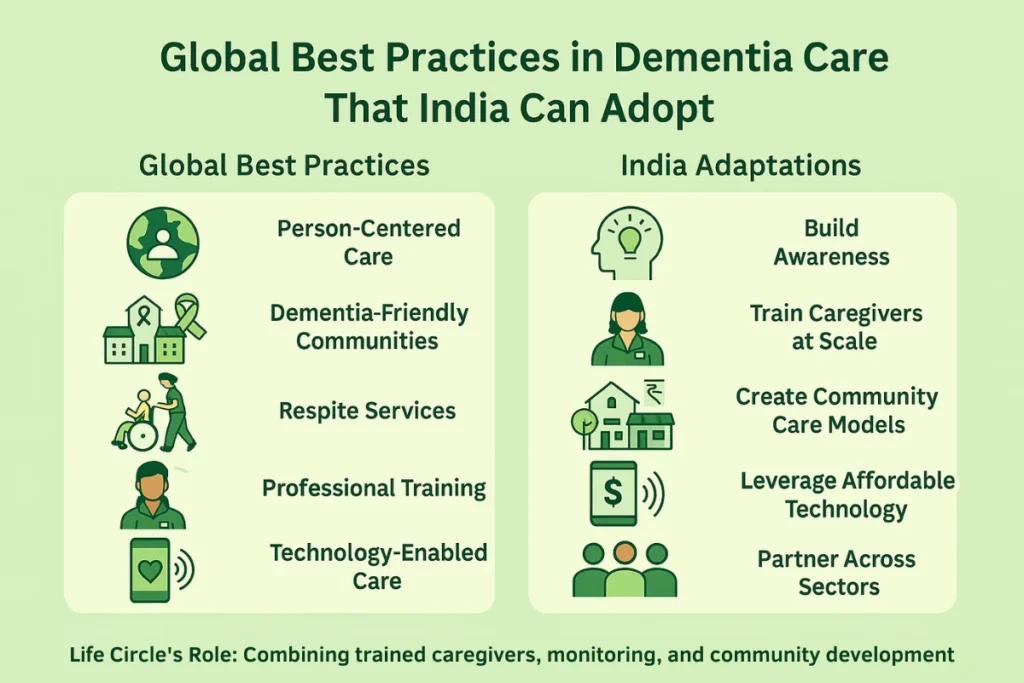
Best Practices Dementia Care: Lessons From Around the World
Leading nations have invested decades in refining dementia care models that are structured, compassionate, and community-driven. Here are the key global approaches that dementia care India can learn from and adapt.
Person-Centered Care (UK and USA)
One of the most widely adopted global best practices in dementia care is the person-centered care model, pioneered extensively in the UK and USA. This approach focuses on:
- Recognizing the individual’s unique personality, personal history, and preferences.
- Designing care plans tailored to specific needs rather than simply managing medical conditions.
- Actively encouraging dignity, independence, and participation in meaningful daily activities.
Person-centered care has demonstrated measurable improvements in the emotional well-being and quality of life for people living with dementia. It is a foundational principle that dementia care India must prioritize as it builds its care infrastructure.
Dementia-Friendly Communities (Japan and UK)
Japan and the UK have led the global development of dementia-friendly communities — entire cities and towns redesigned and retrained to support people living with dementia. Key features include:
- Physical environments designed with clear signage, safe pathways, and calming spaces.
- Large-scale public awareness campaigns that actively reduce stigma around dementia.
- Training programs for staff in shops, banks, and public transport systems to recognize and assist individuals with dementia.
Creating dementia-friendly communities in Indian cities could transform how seniors with dementia experience daily life and significantly reduce the isolation that many families currently feel.
Caregiver Respite Services (Australia and Canada)
Australia and Canada have invested heavily in caregiver respite services, recognizing that family caregivers are the backbone of dementia care — and that they need regular relief to sustain their own well-being. These programs offer:
- Short-term day-care options so families can take meaningful breaks during the day.
- Overnight and short-stay facilities providing temporary but structured relief.
- Visiting carer services that bring professional support directly into the home.
Dementia caregiver training combined with structured respite services significantly reduces caregiver burnout — a problem that is widespread but deeply underaddressed in India today.
Dementia Caregiver Training and Certification (Germany and Singapore)
Germany and Singapore have built structured national certification programs for dementia caregivers, elevating caregiving into a respected and skilled profession. Key elements include:
- Formal training curricula covering dementia stages, behavioral management, and communication techniques.
- Continuous upskilling through workshops, seminars, and digital learning platforms.
- National standards that ensure consistent, high-quality care across all providers.
Investing in dementia caregiver training at scale is one of the most impactful steps India can take. Institutions like CareVidya Academy are already working in this direction, with dedicated dementia care modules designed to train thousands of youth across the country.
Technology-Enabled Dementia Care (Singapore and USA)
Singapore and the USA have demonstrated how technology can extend and enhance dementia care without replacing the irreplaceable human touch:
- GPS tracking devices help keep seniors who are prone to wandering safe at all times.
- Mobile apps provide medication reminders, family updates, and real-time monitoring of daily activity.
- AI-based tools support cognitive stimulation and early detection of behavioral changes.
Affordable technology solutions can be deployed widely in India, making quality dementia care more accessible even in resource-limited settings.
How India Can Adapt Global Best Practices for Dementia Care
Adapting global best practices for dementia care in India requires a multi-layered strategy that addresses awareness, training, infrastructure, and policy simultaneously.
Build Nationwide Awareness
Large-scale campaigns must educate families about dementia symptoms, progression, and available care options. Early awareness leads to earlier diagnosis and significantly better outcomes for patients and families alike.
Train Caregivers at Scale
Institutions like CareVidya Academy can train thousands of caregivers annually with specialized dementia modules covering communication strategies, safety protocols, behavioral support, and emotional care techniques.
Create Community-Based Care Models
Pilot dementia day-care centers in major cities such as Hyderabad Bengaluru, and Delhi NCR can offer cognitive stimulation activities and family respite — addressing both senior well-being and caregiver exhaustion at the community level.
Leverage Affordable Technology
Mobile applications for monitoring, caregiver communication, and family updates can bridge the gap between professional care and home-based support, making dementia management more practical and sustainable for everyday Indian families.
Build Cross-Sector Partnerships
Governments, NGOs, corporate CSR programs, and care providers like Life Circle must collaborate to develop and scale dementia care models that are both high-quality and financially accessible to families across income levels.
Life Circle's Approach to Global Best Practices Dementia Care India
Life Circle has already begun integrating the global best practices dementia care India needs into its service delivery model. With over 7,000 families supported, Life Circle’s approach reflects both clinical rigor and compassionate, person-centered values that align with internationally proven standards.
Key features of Life Circle’s dementia care model include:
- Trained dementia caregivers supervised directly by qualified nurses to ensure consistent safety and quality.
- Personalized Patient Care Plans (PCPs) designed to match each senior’s unique history, preferences, and medical requirements.
- Access to the CareTube app for ongoing caregiver training and continuous skill development.
- Transparent family communication with a caregiver replacement guarantee within 24–48 hours to maintain uninterrupted continuity of care.
Active exploration of pilot dementia community programs in Hyderabad and Delhi NCR to bring structured day-care and respite models directly to Indian families.
📌 Dementia care packages at Life Circle start from ₹35,000/month, with pricing varying by city and the level of care required.
Challenges to Implementing Dementia Care Best Practices in India
While the roadmap is clear, several significant challenges must be acknowledged and proactively addressed:
- Cost Barriers: Specialized dementia care remains unaffordable for many Indian families without meaningful subsidies or insurance support.
- Cultural Preferences: Most Indian seniors prefer aging at home, requiring community care models to be thoughtfully adapted for home-based or hybrid care settings.
- Policy Gaps: India currently lacks a comprehensive national dementia strategy, leaving families without institutional guidance or systemic support to navigate the care journey.
Opportunities on the Horizon for Dementia Care India
Despite these challenges, there are significant and growing opportunities that make this the right moment to invest in dementia care infrastructure:
Government initiatives like the SAGE Seniorcare Ageing Growth Engine program can be expanded to include dementia-specific projects and dedicated funding streams.
- Corporate Social Responsibility (CSR) funding and philanthropic investment can support pilot dementia-friendly community initiatives in Tier 1 and Tier 2 cities across India.
- India can strategically position dementia caregiving as a significant job creation engine, generating skilled employment for millions of young people while simultaneously addressing a growing public health crisis.
The convergence of a rapidly aging population, increasing public awareness, and emerging care infrastructure means that now is the right time to act decisively.
Conclusion
The global best practices dementia care India must urgently adopt are well-documented and proven across multiple countries — what is needed now is the collective will, sustained investment, and cross-sector collaboration to bring them to scale. By embracing person-centered care, dementia-friendly communities, structured dementia caregiver training, and technology-enabled solutions, India can build a care system that genuinely supports both seniors and their families.
Life Circle is committed to leading this transformation — combining trained caregivers, tech-enabled monitoring, transparent family communication, and community partnerships to deliver dementia care with dignity, compassion, and lasting impact.
The time to act is now. India’s 8 million families living with dementia deserve nothing less.