29-09-2025
Eldercare Tier 2 Tier 3 Cities India Next Frontier: Unlocking Growth and Opportunity
Written By: Manisha Gangadhara, Caregiving Insights Writer
Introduction:
Eldercare Tier 2 Tier 3 Cities India Next Frontier represents a transformative shift in how India approaches senior care. Historically, India’s eldercare industry has concentrated its resources and services in metropolitan hubs like Delhi, Mumbai, and Bengaluru. However, a significant and silent revolution is now emerging in Tier-2 and Tier-3 cities such as Patna, Lucknow, Chandigarh, and Coimbatore, where demand for professional caregiving services is rising at an unprecedented pace.
With rapid urbanization and young people migrating to major metros for employment opportunities, many seniors in smaller cities find themselves living alone or with limited family support systems. This demographic shift has transformed professional eldercare from a luxury service into an urgent necessity for families across Tier-2 and Tier-3 cities.
Why Eldercare Tier 2 Tier 3 Cities India Next Frontier Matters
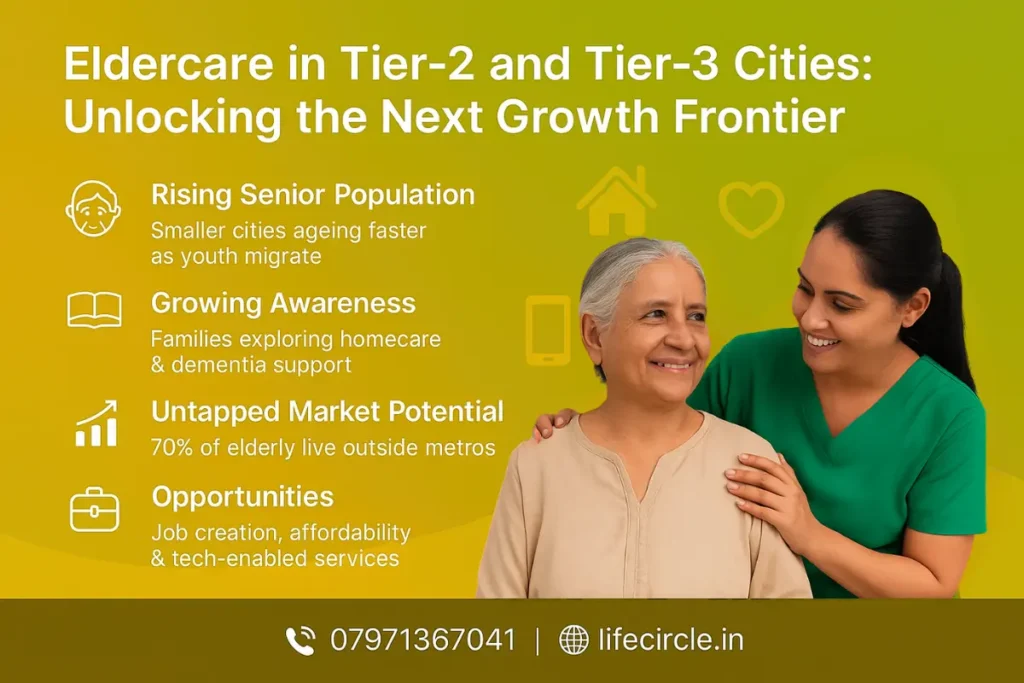
Rising Senior Population in Smaller Cities
India’s elderly population is growing faster in Tier-2 and Tier-3 cities than in metropolitan areas. As younger generations migrate to major cities for better economic opportunities, seniors often remain behind in their hometown communities. This trend creates a unique challenge: aging populations with reduced family support networks require professional care services that have traditionally been unavailable in these regions.
Demographic studies indicate that by 2030, the concentration of elderly individuals in non-metro cities will increase significantly, making eldercare in small towns not just relevant but critically important for family well-being and social stability.
Growing Awareness and Acceptance
Families in Tier-2 and Tier-3 cities are increasingly becoming aware of professional eldercare solutions, including:
- Home-based care services for daily living assistance
- Assisted living arrangements for seniors with mobility challenges
- Specialized dementia and Alzheimer’s care support
- Nursing and medical assistance in home settings
While healthcare infrastructure in smaller cities has expanded considerably, these regions still lack comprehensive home-based care networks. This gap presents both a challenge and an opportunity for service providers committed to expanding eldercare India beyond metropolitan boundaries.
Untapped Market Potential
One of the most compelling statistics in the eldercare sector is this: approximately 70% of India’s elderly population lives outside metropolitan areas. Yet, the vast majority of professional eldercare services and infrastructure remain concentrated in metros. This massive service gap represents tremendous opportunity for:
- Expanding professional eldercare networks
- Creating employment opportunities for local communities
- Providing affordable, accessible care solutions
- Building sustainable business models in underserved markets
Challenges in Expanding Eldercare Beyond Metropolitan Areas
Shortage of Trained Caregiving Workforce
One of the most significant barriers to expanding eldercare Tier-2 and Tier-3 cities is the acute shortage of professionally trained caregivers. Unlike metropolitan centers where training institutes and certification programs are readily available, smaller cities often lack structured caregiving education and skill development opportunities. This gap means that many seniors receive care from untrained individuals without proper knowledge of:
- Patient safety protocols
- Proper lifting and mobility techniques
- Hygiene and disease prevention standards
- Communication with healthcare providers
- Emergency response procedures
Limited Healthcare and Support Infrastructure
Tier-2 and Tier-3 cities generally have fewer medical facilities, nursing homes, and specialized eldercare centers compared to metropolitan regions. This infrastructure limitation creates challenges for:
- Accessing specialist medical consultations
- Emergency medical response and hospitalization
- Integrated care coordination
- Advanced diagnostic services
- Rehabilitation and therapy services
Affordability and Pricing Sensitivity
Families in smaller towns typically operate with lower household incomes compared to metro populations. They are understandably more cost-sensitive when evaluating eldercare services. Successful expansion into these markets requires:
- Transparent and affordable pricing models that reflect local economic conditions
- Flexible payment options and service packages
- Value-for-money service offerings
- Clear communication about service inclusions and costs
Opportunities in Tier-2 and Tier-3 Eldercare Markets
Job Creation for Local Youth and Communities
Expandable eldercare services create meaningful employment opportunities for local populations. Caregiving can provide dignified, stable employment for:
- Rural and peri-urban youth seeking professional careers
- Women looking for flexible, respectful work opportunities
- Individuals from economically disadvantaged backgrounds
- School and college graduates entering the workforce
Structured training programs and academies can scale rapidly in smaller towns, creating career pathways that empower local communities while addressing the senior care crisis.
Peace of Mind for NRI and Migrant Families
Thousands of non-resident Indians and urban migrants maintain emotional and financial responsibility for aging parents in their hometowns. Home care in Tier-2 cities offers these families:
- Reliable, professional care for elderly parents
- Regular updates and monitoring through technology
- Reduced anxiety about parental well-being
- Ability to maintain family connections across distances
- Quality of life assurance for aging parents
Technology-enabled monitoring bridges geographical distances, allowing families to remain connected and informed about their parents’ daily care, health status, and activities.
Service Differentiation and Value Addition
Successful eldercare Tier-2 and Tier-3 cities operations can differentiate themselves by offering specialized, value-added services including:
- Physiotherapy and rehabilitation services for post-recovery care
- Nutritional counseling and diet planning tailored to individual health conditions
- Dementia care and cognitive support for seniors with memory-related conditions
- Mental health support addressing depression and anxiety in aging populations
- Companionship and social engagement programs combating loneliness
- Medication management and health monitoring ensuring treatment adherence
These specialized services can be scaled effectively to smaller cities, creating comprehensive care ecosystems that serve seniors holistically.
Implementation and Service Models
Training and Workforce Development
Successful expansion into Tier-2 and Tier-3 markets requires investment in local training infrastructure. Dedicated caregiving academies can:
- Provide structured, certified caregiving education
- Develop professional competencies and soft skills
- Create employment pathways for trained graduates
- Establish quality standards across service providers
- Build community awareness about professional caregiving
Technology-Enabled Care Coordination
Modern eldercare services leverage technology to ensure quality, transparency, and family connection:
- Mobile applications for family communication and monitoring
- Digital health records and care documentation
- Real-time activity tracking and alerts
- Integrated billing and payment systems
- Caregiver performance monitoring and feedback mechanisms
Supervision and Quality Assurance
Professional eldercare in smaller cities requires:
- Trained nursing care managers overseeing caregiver performance
- Regular health assessments and care plan adjustments
- Coordination with local healthcare providers
- Family communication and feedback integration
- Continuous training and skill development for caregivers
Transparent and Accessible Pricing
Successful models in Tier-2 and Tier-3 markets feature:
- Clear, transparent pricing structures without hidden costs
- Flexible service packages accommodating different budget levels
- Affordable entry points for middle and lower-middle-income families
- Value-based service offerings
- Multiple payment options and flexible scheduling
Impact and Benefits
For Seniors and Families
Eldercare Tier-2 and Tier-3 cities services provide:
- Access to professional, compassionate care in home environments
- Maintenance of independence and dignity in familiar surroundings
- Improved health outcomes through consistent monitoring and support
- Reduced family stress and burden
- Better quality of life and social engagement
For Local Communities
Expanding eldercare creates:
- Stable employment opportunities for local youth
- Economic development and income generation
- Skills development and professional growth
- Enhanced community well-being through improved elder care
- Strengthened social safety nets for vulnerable populations
For Healthcare Systems
Professional home care in Tier-2 cities reduces:
- Strain on hospital beds and medical facilities
- Emergency department overcrowding
- Healthcare costs through preventive in-home care
- Complications from inadequate long-term care
- Pressure on institutional facilities
Conclusion
Eldercare Tier 2 Tier 3 Cities India Next Frontier represents far more than a business opportunity—it embodies a social imperative to ensure that quality, professional senior care becomes accessible across the entire nation, not just in metropolitan centers.
Tier-2 and Tier-3 cities represent the authentic next growth frontier for India’s eldercare sector. When combined with the right mix of affordability, structured training, technology integration, and compassionate service delivery, families in smaller cities can access professional eldercare services equivalent to those available in major metros.
By investing in local training infrastructure, deploying qualified caregivers under professional supervision, integrating technology for monitoring and communication, and maintaining transparent pricing models, organizations can build sustainable, scalable eldercare systems that:
- Empower elderly individuals to age with dignity in their own homes
- Provide peace of mind for families and NRI relatives
- Create meaningful employment for local youth
- Strengthen community care networks
- Build a more compassionate and inclusive eldercare landscape across India
The transformation of eldercare in small towns from an aspiration to a reality is not merely possible—it is essential for India’s demographic future. Through commitment to quality, affordability, and community engagement, the next frontier of eldercare will create lasting value for seniors, families, and communities across Tier-2 and Tier-3 cities nationwide.