29-09-2025
The Untapped Potential of Care Economy India
Written By: Manisha Gangadhara, Caregiving Insights Writer
Introduction:
The care economy India represents one of the most significant and overlooked opportunities in the country’s economic landscape. India’s population is ageing faster than ever before. By 2050, one in five Indians will be over 60 years old — a demographic shift that is quietly reshaping the nation’s social and economic fabric. This transformation is driving the rise of the care economy, a sector that encompasses caregiving, nursing, eldercare technology, and a wide range of related support services.
Despite its enormous size and growing importance, the care economy in India remains largely informal and underdeveloped. With the right investments, structured training, and forward-thinking policies, it holds the power to unlock millions of dignified jobs, empower underserved communities, and dramatically improve the quality of life for seniors and their families across the country.
What Is the Care Economy?
The care economy includes all paid and unpaid services that support people who cannot fully care for themselves — including the elderly, children, and individuals living with disabilities. It spans home-based caregiving, institutional eldercare, assistive technologies, physiotherapy, palliative care, and more.
In India, caregiving has traditionally been informal — carried out within households, predominantly by women, without recognition, compensation, or structured support. However, a shift is underway. Professional caregiving services are gradually emerging as a structured industry, driven by rising demand, changing family structures, and growing awareness among urban families about the importance of quality eldercare.
Understanding the full scope of the care economy is the first step toward recognising its true potential — and the urgency of developing it.
Why the Care Economy India Is Still Untapped
Despite its promise, the care economy India faces several systemic barriers that have kept it from reaching its full potential.
Growing Demand, Limited Supply
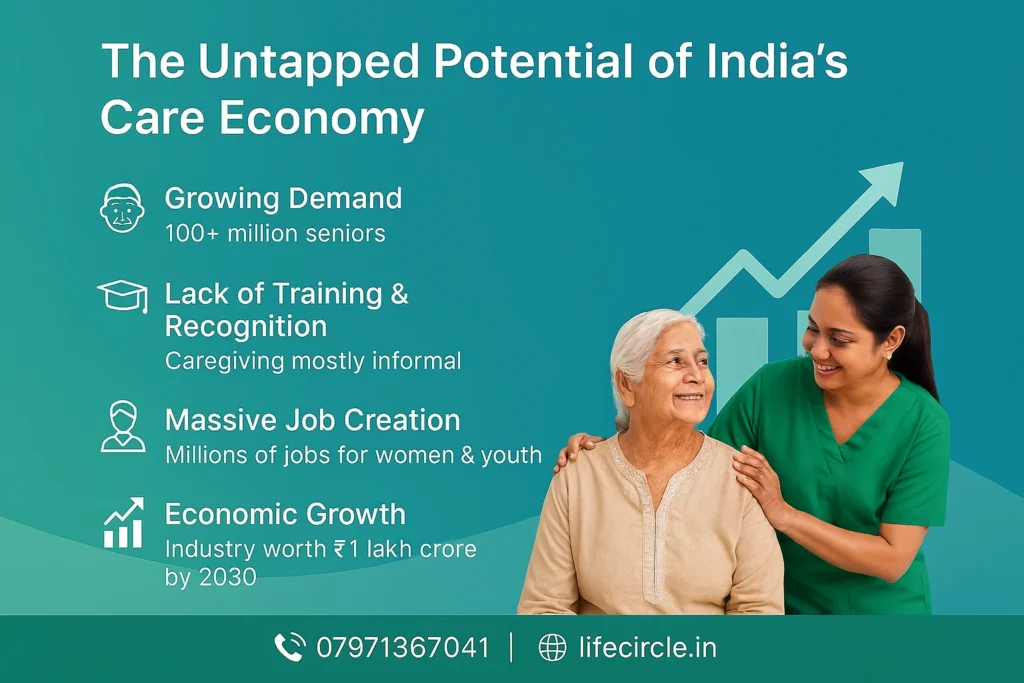
India is home to over 100 million senior citizens today, a number that is set to rise sharply over the next two decades. Yet the supply of trained, certified caregivers falls dramatically short of what is needed. Most families are left navigating an unorganised market of untrained helpers with no quality standards, no accountability, and no continuity of care.
This gap between demand and supply is not just a social problem — it is a missed economic opportunity of staggering proportions.
Lack of Training and Professional Recognition
Caregiving is not widely recognised as a formal profession in India. There is no standardised national curriculum, no regulated certification body, and very few institutions that offer structured, skill-based training for aspiring caregivers. As a result, millions of potential workers — particularly women and rural youth — are excluded from a sector where they could thrive.
Without professional recognition, caregiving continues to be seen as unskilled domestic labour rather than the specialised, compassionate, and highly valued vocation it truly is.
Policy and Funding Gaps
Government support for the eldercare industry India remains limited. Elder-specific care is rarely integrated into mainstream health and employment schemes. Insurance products that cover home-based long-term care are virtually nonexistent for most Indian families. Without policy intervention and public investment, the sector will continue to develop in an ad hoc, fragmented manner — failing both caregivers and care recipients alike.
The Enormous Potential of India's Care Economy
Addressing these challenges unlocks transformative possibilities — for individuals, families, and the Indian economy at large.
Massive Job Creation Through Caregiving
One of the most compelling dimensions of the care economy is its potential for jobs in caregiving at scale. Millions of caregiving roles can be created over the next decade, with most opportunities benefiting women, rural youth, and individuals from economically disadvantaged backgrounds.
Unlike many emerging job sectors that require advanced degrees or technical expertise, caregiving can be entered with structured vocational training — making it one of the most inclusive employment opportunities available to India’s workforce. From home attendants and nursing aides to dementia specialists and palliative care professionals, the spectrum of roles is wide and growing.
Estimates suggest that the eldercare industry alone could generate over 10 million direct and indirect jobs by 2035 if the sector is adequately developed.
Driving Economic Growth
The financial opportunity is equally compelling. The eldercare industry India is projected to become a ₹1 lakh crore industry by 2030. This growth will not be limited to direct caregiving services alone. An entire ecosystem of ancillary services — medical equipment rentals, physiotherapy, digital health platforms, assistive technologies, specialised nutrition, and elder-friendly housing — stands to benefit.
Investing in the care economy is not charity. It is smart economics.
Social Transformation and Empowerment of Women in Caregiving
Beyond employment numbers and revenue projections, the care economy offers a pathway to profound social change. **Women in caregiving** roles gain access to dignified, stable, and meaningful employment — often for the first time. This financial independence strengthens families, improves household wellbeing, and elevates women’s status within their communities.
At the same time, seniors who receive professional, compassionate care experience better health outcomes, lower rates of hospitalisation, and a significantly improved quality of life. Families gain peace of mind, and younger members are better able to focus on their own careers and responsibilities without the constant burden of informal caregiving.
The ripple effects of a well-developed care economy touch every layer of Indian society.
Life Circle's Role in Building the Care Economy
Life Circle is actively working to professionalise and scale the care economy India through a combination of training, technology, and structured service delivery.
- CareVidya Academy trains rural women and youth as certified professional caregivers, equipping them with the clinical knowledge, communication skills, and ethical grounding needed to excel in the field.
- CareTube App enables continuous digital upskilling, ensuring caregivers stay updated with best practices even after placement.
- Life Circle currently creates jobs in caregiving across 12+ cities, including Hyderabad, Bangalore, Chennai, Delhi, Gurgaon, Noida, Pune, Mumbai, Navi Mumbai, Chandigarh, Thane.
Transparent, tech-enabled home care services set quality benchmarks for the broader eldercare industry India.
📌 Caregiver jobs at Life Circle start from ₹18,000/month and go up to ₹45,000/month for specialised roles in dementia care, palliative care, and nursing — offering competitive, dignified livelihoods for women in caregiving and beyond.
Unlocking the Future: What Needs to Happen Next
Realising the full potential of the care economy India will require coordinated action across multiple fronts.
- Policy Support: Caregiving must be formally integrated into national skill development missions, health schemes, and employment programmes. Recognition of caregiving as a skilled profession is the essential first step.
- Public-Private Partnerships: Collaboration between organisations like Life Circle, government bodies, and NGOs can accelerate training, placement, and quality assurance at scale.
- Insurance Coverage: Expanding health and long-term care insurance to include home-based and chronic care services will make professional caregiving accessible to a much larger share of India’s ageing population.
- Awareness Campaigns: Changing societal perceptions is critical. Promoting caregiving as a respected, dignified, and financially rewarding career choice — particularly for women in caregiving — will attract more talent into the sector and raise its profile nationally.
These steps are not aspirational — they are actionable, and the time to act is now.
Conclusion
The care economy India is a sleeping giant. It sits at the intersection of one of the country’s most pressing demographic challenges and one of its most promising economic opportunities. By investing in caregiver training, embracing technology, and building structured, accountable service delivery systems, India can transform this sector into both a powerful job-creation engine and a meaningful solution to the eldercare crisis.
The eldercare industry India does not need to remain informal, invisible, and underfunded. With the right intention and investment, it can become a cornerstone of India’s inclusive growth story — creating dignified jobs in caregiving, empowering women in caregiving, and ensuring that every senior Indian receives the compassionate, professional care they deserve.
Life Circle is committed to leading this transformation — one caregiver, one family, one city at a time.
Frequently Asked Questions
What is the care economy and why is it important for India?
The care economy refers to all paid and unpaid services that support individuals who cannot fully care for themselves — including the elderly, children, and people with disabilities. For India, it is particularly important because the country is experiencing rapid demographic ageing. With over 100 million senior citizens today and projections showing one in five Indians will be over 60 by 2050, the demand for structured, professional caregiving is growing at an unprecedented rate. Developing the care economy India can simultaneously address this social challenge while generating millions of jobs and driving significant economic growth.
How many jobs can the caregiving sector create in India?
The caregiving sector has immense job-creation potential. Estimates indicate that the eldercare industry alone could generate over 10 million direct and indirect jobs by 2035, provided the sector receives adequate investment, policy support, and structured training infrastructure. Jobs in caregiving range from home attendants and nursing aides to dementia specialists, physiotherapists, and palliative care professionals — making it one of the most diverse and inclusive employment ecosystems in the country.
How does the care economy empower women in India?
Women in caregiving roles benefit significantly from the formalisation of the care economy. Historically, women have provided unpaid, unrecognised caregiving within households. When this work is professionalised — through certified training programmes, structured employment, and competitive salaries — women gain financial independence, social recognition, and long-term career stability. Organisations like Life Circle are at the forefront of this shift, offering caregiver roles with salaries ranging from ₹18,000 to ₹45,000 per month, specifically designed to create dignified livelihoods for women in underserved communities.
What steps are needed to unlock the full potential of the eldercare industry in India?
Unlocking the full potential of the eldercare industry India requires action on several fronts. First, the government must formally integrate caregiving into national skill development and health schemes, recognising it as a skilled profession. Second, public-private partnerships between organisations, government bodies, and NGOs can scale training and placement rapidly. Third, expanding insurance coverage to include home-based and long-term care services will make professional eldercare accessible to more families. Finally, national awareness campaigns are essential to reframe caregiving as a respected, financially rewarding career — attracting more talent and elevating the sector’s overall quality and credibility.