28-09-2025
How Public-Private Partnerships Eldercare India Can Transform Senior Care
Written By: Nagaraju Raparthi, Senior Content & Care Story Writer
Introduction:
Public-private partnerships eldercare India is no longer just a policy idea — it is an urgent necessity. Eldercare in India stands at a critical turning point. With the country’s senior population growing at an unprecedented pace, families alone can no longer bear the full weight of caregiving responsibilities. While the government has introduced several welfare programs for seniors over the years, these initiatives remain underfunded, understaffed, and underutilized across most states.
This is precisely where public-private partnerships (PPPs) in eldercare can make a transformative difference — by strategically combining the scale and reach of government programs with the innovation, efficiency, and expertise of private care providers. Together with community-based organizations, PPPs can build a senior care ecosystem that is both accessible and sustainable for millions of ageing Indians.
Why India Urgently Needs PPP Eldercare Solutions
The demographic reality facing India cannot be ignored. The country is ageing faster than its care infrastructure can keep up with. Understanding the scale of this challenge is the first step toward designing meaningful solutions.
Rising Demand for Senior Care:
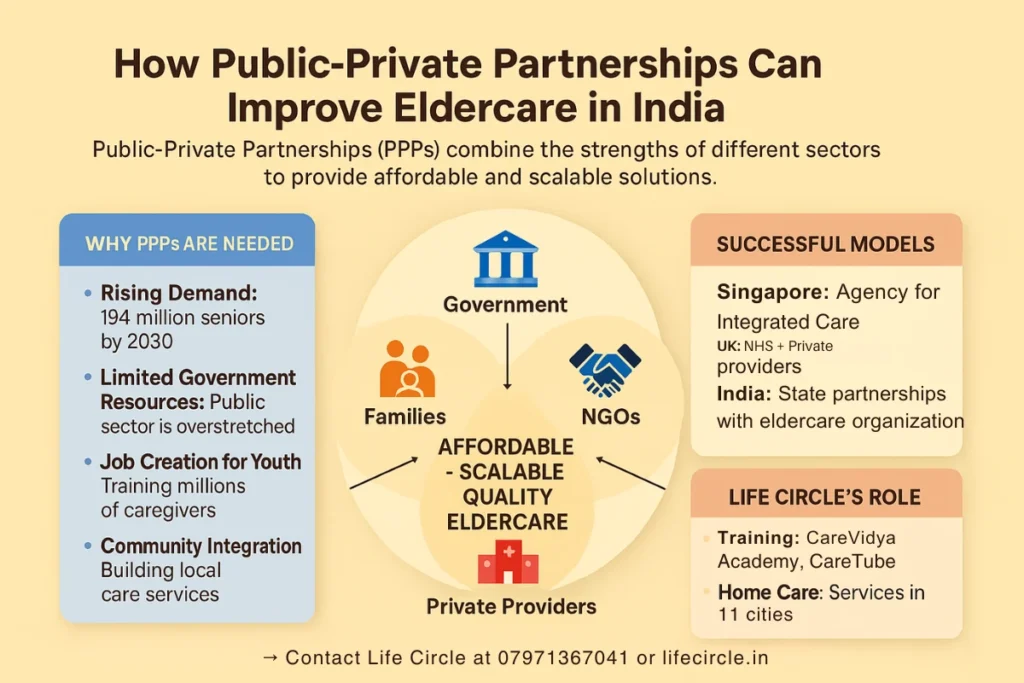
By 2030, India will have an estimated 194 million senior citizens, creating unprecedented demand for home-based care, dementia support, palliative services, and long-term assisted living. The current infrastructure — both public and private — is far from prepared to meet this scale.
Limited Government Resources:
Public hospitals and government-run welfare schemes are already overstretched. Budget allocations for geriatric care remain a small fraction of the overall health expenditure. Senior care public-private collaboration allows governments to extend their reach by tapping into the expertise, networks, and operational efficiency of established private providers.
Job Creation and Workforce Development:
Eldercare has the potential to generate millions of caregiving and allied health jobs across India. When private training institutions collaborate with government skilling programs, it creates a trained, certified, and employable workforce ready to serve a growing senior population.
Community Integration and Social Support:
PPPs can enable the development of day-care centres, home care networks, and dementia-friendly communities in partnership with NGOs, panchayati raj institutions, and urban local bodies. This ensures that eldercare reaches seniors not just in metros but also in Tier 2 and Tier 3 cities.
Successful Global Models of PPP in Eldercare
Before designing India-specific solutions, it is valuable to look at what has worked globally. Several countries have successfully implemented ageing India partnerships-style frameworks that India can learn from and adapt.
Singapore’s Agency for Integrated Care (AIC):
Singapore’s government and private partners jointly operate day-care centres, caregiver training programs, and home health services under a unified national framework. The result is a seamlessly integrated system where seniors receive consistent, quality care regardless of their income level.
The United Kingdom’s NHS and Private Provider Model:
In the UK, the National Health Service collaborates with private and voluntary organizations to deliver community-based senior services. This integrated approach has helped reduce hospital readmissions and improved quality of life for seniors living at home.
Australia’s Aged Care Packages:
Australia funds home care packages that families can use to hire government-approved private care providers. This consumer-directed model gives seniors choice and dignity while maintaining accountability through government oversight.
These global models demonstrate one clear principle: when governments set the framework and private providers deliver the service, the quality, scale, and efficiency of eldercare improve significantly.
PPP Eldercare India: Key Opportunities and Strategies
For PPP eldercare India to succeed, a multi-layered strategy is required — one that addresses training, service delivery, technology, and policy simultaneously.
1. Caregiver Training and Certification at Scale
One of the biggest gaps in India’s eldercare system is the lack of trained, certified caregivers. State governments can partner with specialized training academies to create standardized curricula, conduct assessments, and issue nationally recognized certifications. This ensures that every caregiver deployed — whether in a metro or a small town — meets a consistent standard of care.
Collaborations between government skilling bodies like the National Skill Development Corporation (NSDC) and private eldercare training institutions can fast-track the creation of a professional caregiving workforce across India.
- Affordable Home-Based Care Packages
Millions of Indian seniors prefer to age in their own homes, surrounded by family and familiar environments. PPPs can make affordable home-based care packages a reality by combining government subsidies with private sector delivery systems. This model reduces the burden on hospitals, lowers costs for families, and enables seniors to receive medical and personal care in the comfort of their homes.
- Senior Drop-In Centres and Day-Care Networks
Urban and semi-urban areas can benefit greatly from a network of senior drop-in centres co-funded by government bodies and managed by private organizations. These centres provide social engagement, health monitoring, physiotherapy, and mental wellness programs — reducing isolation among seniors and offering respite to family caregivers.
4. Technology-Enabled Supervision and Reporting
Digital tools are essential for scaling eldercare quality assurance. Technology platforms that enable remote supervision, real-time reporting, and family engagement can help PPP stakeholders monitor care delivery, track health outcomes, and respond quickly to emergencies. Mobile applications can bridge the gap between caregivers, families, and supervisors — ensuring transparency and accountability at every level.
- Integrated Dementia and Palliative Care Programs
Conditions like dementia require specialized, long-term care that neither families nor general hospitals are equipped to provide alone. PPPs focused specifically on dementia care and palliative services can fund dedicated care units, train specialized caregivers, and build community awareness programs that reduce stigma and improve early diagnosis rates.
The Role of Private Eldercare Providers in Shaping PPP Models
Private eldercare organizations that already operate at scale bring something invaluable to PPP frameworks: real-world experience, operational systems, and established trust with families. These organizations understand what caregiving looks like on the ground — the challenges, the gaps, and the innovations that actually work.
A successful ageing India partnerships model would involve private providers in three critical areas:
- Workforce Development: Training and deploying certified caregivers through accredited academies and digital learning platforms, ensuring a steady pipeline of skilled professionals.
- Direct Care Delivery: Operating structured, supervised home care and community care programs in cities across India — from major metros like Hyderabad, Bengaluru, Chennai, Mumbai, and Delhi NCR to growing urban centres like Pune, Noida, Gurgaon, Chandigarh, and Navi Mumbai.
- Technology and Innovation: Leveraging digital platforms for care coordination, progress tracking, family communication, and data-driven quality improvement — capabilities that government systems currently lack.
When private providers with these capabilities partner with government agencies, the result is a care system that is both efficient and compassionate — combining the accountability of public governance with the agility of private enterprise.
Challenges to Overcome in Building PPP Eldercare Frameworks
While the potential of public-private partnerships eldercare India is enormous, there are real challenges that policymakers and private players must address together:
- Regulatory Clarity: India currently lacks a comprehensive national eldercare regulation. Establishing clear licensing, quality standards, and grievance mechanisms is essential for PPPs to function effectively.
- Funding Structures: PPP models require well-designed funding arrangements — including performance-based payments, co-funding mechanisms, and transparent accountability systems — to prevent resource misallocation.
- Rural Outreach: Extending PPP eldercare models beyond cities to rural and semi-urban areas requires innovative delivery approaches, including mobile care units, telemedicine, and community health worker networks.
- Family Awareness: Many Indian families are still unfamiliar with formal eldercare services. PPPs must include robust awareness and sensitization campaigns to build acceptance and uptake.
A Roadmap for Scaling PPP Eldercare Across India
To move from isolated pilots to a national system, India needs a phased and structured roadmap for senior care public-private collaboration:
Phase 1 – Pilot Programs: Launch PPP eldercare models in 5 to 10 states, focusing on home care, caregiver training, and senior wellness centres.
Phase 2 – Policy Framework: Develop a national PPP eldercare policy with standardized contracts, quality benchmarks, and funding guidelines.
Phase 3 – Scale and Replication: Use learnings from pilot programs to scale successful models across all states, with special focus on Tier 2 and Tier 3 cities and rural districts.
Phase 4 – Continuous Improvement: Build feedback loops using technology and data to continuously improve care quality, workforce performance, and family satisfaction.
Conclusion
Public-private partnerships eldercare India represent the most viable and scalable path toward a dignified ageing future for millions of Indian seniors. By combining the reach and funding capacity of government programs with the operational expertise and innovation of private providers, India can build a care ecosystem that is affordable, high-quality, and available to all — regardless of income or geography.
The time to act is now. With 194 million seniors projected by 2030, every year of delay means millions of families struggling without the support they deserve. PPP eldercare India is not just a policy option — it is a national imperative.